

























TMC Poised for Another Victory in Bengal - Chanakya Strategies
#mamatabenrejee, #tmc, #westbengalelections, #chanakyastrateges
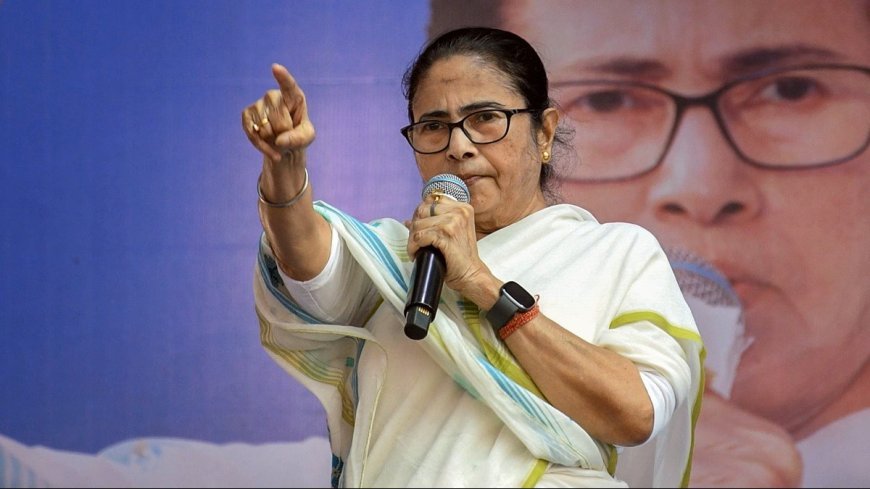
The ruling All India Trinamool Congress (TMC) appears firmly on track to retain power in West Bengal, with recent pre-poll assessments indicating a clear advantage over its rivals. Despite visible undercurrents of anti-incumbency in certain sections, particularly among youth and government employees, the overall electoral arithmetic continues to favor the party led by Mamata Banerjee.
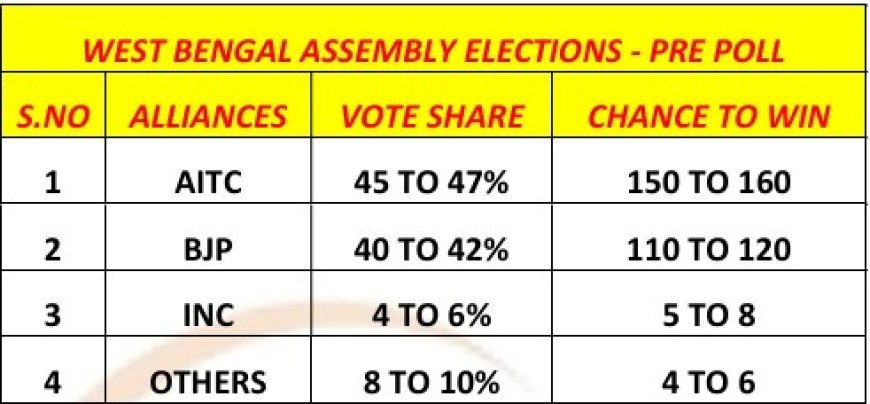
According to the Chanakya Strategies survey trends, TMC is projected to secure around 45–47 percent of the vote share, translating into approximately 150 to 160 seats in the 294-member Assembly. This would comfortably place the party above the majority mark, reinforcing its dominant position in the state’s political landscape. In contrast, the Bharatiya Janata Party (BJP) is expected to garner 40–42 percent votes, with an estimated 110 to 120 seats—an improvement in presence but insufficient to challenge TMC’s lead.
One of the key factors working in TMC’s favor is the state’s unique social and demographic composition. Unlike northern states where caste plays a decisive role, West Bengal’s politics is shaped more by religious and regional voting patterns. A cohesive minority vote, particularly among Muslims who constitute roughly 27 percent of the population, continues to consolidate behind TMC. In the previous Assembly elections, the party swept the vast majority of constituencies with significant minority populations, a trend that appears likely to persist.
Additionally, welfare schemes implemented by the state government have had a tangible impact on voters, especially in rural areas. Programs focused on direct benefit transfers, food security, and social support have strengthened TMC’s grassroots connect. These initiatives have translated into consistent electoral backing in regions heavily dependent on state assistance.
While the BJP has made notable inroads over the past decade—expanding its vote share significantly and consolidating support in urban and semi-urban belts—the fragmented nature of other voter groups, including Scheduled Castes and other communities, limits its ability to convert votes into decisive seat gains.
The Congress and Left parties, once dominant forces in the state, continue to struggle, with minimal vote share and limited electoral prospects. Their decline has effectively turned West Bengal into a bipolar contest, but one where TMC maintains a decisive upper hand.
As the political battle intensifies, the broader picture remains clear: despite challenges and opposition momentum, the Trinamool Congress is once again emerging as the frontrunner, with strong indications that it will secure another term in power.