










Clearing dues key to sustaining NTR Vaidya Seva services
#NTRVAIDYASEVA, #cbn, #tdp, #apnews
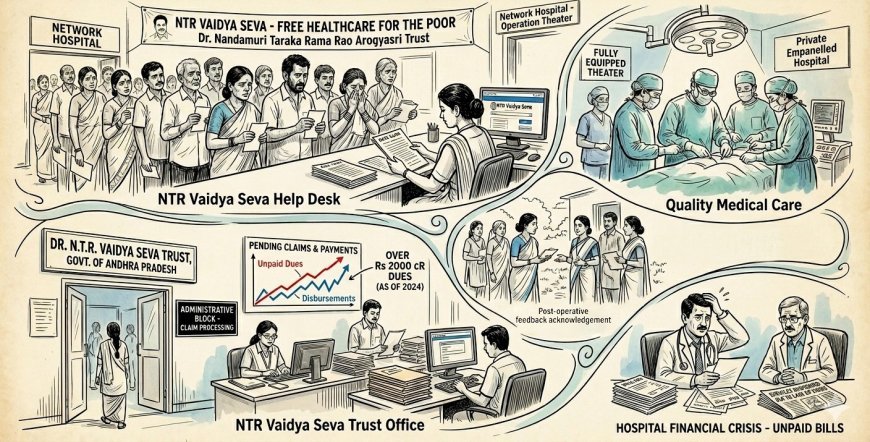
Despite political transitions, flagship healthcare schemes like Aarogyasri, now continued as NTR Vaidya Seva, have remained indispensable for the poor in the state. However, mounting unpaid hospital bills threatens the smooth functioning of these life-saving initiatives.
Successive governments have expanded the scope of the scheme with new sub-programmes aimed at widening access. Yet, inadequate financial planning and delayed reimbursements have pushed both private and government network hospitals into a financial crisis. According to ASHA representatives, dues worth nearly Rs 1,500 crore accumulated during the previous administration led by Y. S. Jagan Mohan Reddy. In the past two years, an additional Rs 500 crore has reportedly piled up, worsening the situation, even as it is regularly monitored by the minister for Health, Satya Kumar Yadav.
Healthcare providers say that nearly Rs 180 crore to Rs 200 crore is required every month to settle claims. However, payments have been inconsistent, forcing hospitals to periodically suspend services. This disruption has left patients, especially those from economically weaker sections, struggling to access timely treatment.
|
Govt, ASHA reach agreement on Rs 2,000 Cr dues, protest calles off TPN, Amaravati The state government has held crucial talks with the Andhra Pradesh Super Speciality Hospitals Association (ASHA) over long-pending dues of nearly Rs 3,000 crore (Including dues to the government hospitals) under the NTR Vaidya Seva scheme, offering relief to network hospitals and raising hopes of restoration of services. Speaking to True Point, Secretary of Health, Medical and Family Welfare Sourab Gaur said the government had responded positively to the concerns raised by hospitals. “We have negotiated with them and considered their demands. They may be inclined to call it off today,” he said, referring to the boycott call of emergency services by ASHA. As part of the discussions, ASHA leaders agreed to a proposal for bill discounting at around 8% annual bank interest. The government stated that out of Rs 2,009 crore worth of pending private hospital bills, about Rs 890 crore is awaiting fund clearance, while nearly Rs 1,000 crore (including bills under scrutiny) may be routed through a bill discounting system via financial institutions. Further, the government assured that monthly claims of private hospitals would be cleared at Rs 150 crore to Rs 170 crore. It also proposed the use of Artificial Intelligence to speed up the scrutiny and settlement of claims. However, sources indicated that there were no detailed discussions regarding the pending dues of government network hospitals during the meeting. Officials said the issue would be taken up separately at a later stage. Both sides also agreed to form a committee to work on a proposed Universal Health Policy. Speaking to True Point, ASHA president Dr. K. Vijay Kumar said, “The government has assured monthly payments and clearing of Rs 1,000 crore within 10 days. While we are satisfied, the protest has been suspended only temporarily based on past experiences.” ASHA secretary Dr Ch. Avinash urged the government to strictly adhere to commitments. “We hope timely payments will prevent future disruptions in healthcare services,” he said. |
The newly formed coalition government under Chief Minister N. Chandrababu Naidu has acknowledged the crisis and initiated steps to address it. On Tuesday, the government agreed to clear Rs 1,000 crore within 10 days out of the total Rs 2,009 crore owed to private hospitals. It also committed to settling the remaining amount by the end of the second financial quarter.
In a significant shift from past practices, the government has also promised to release Rs 150 crore to Rs 180 crore every month towards ongoing claims. Officials believe that regularising payments could prevent service disruptions and restore confidence among healthcare providers.
Experts point out that while isolated instances of malpractice may exist, the majority of hospitals depend on timely reimbursements to sustain operations. Delays not only strain hospital finances but also compromise patient care.
If the government, which allocates crores in the budget to the health sector, maintains a consistent payment schedule and earmarks funds in advance, the scheme could function smoothly, ensuring uninterrupted treatment for beneficiaries. Such measures are crucial to achieving the broader goal of a ‘Healthy Andhra Pradesh’ and strengthening public trust in welfare-driven healthcare systems.