
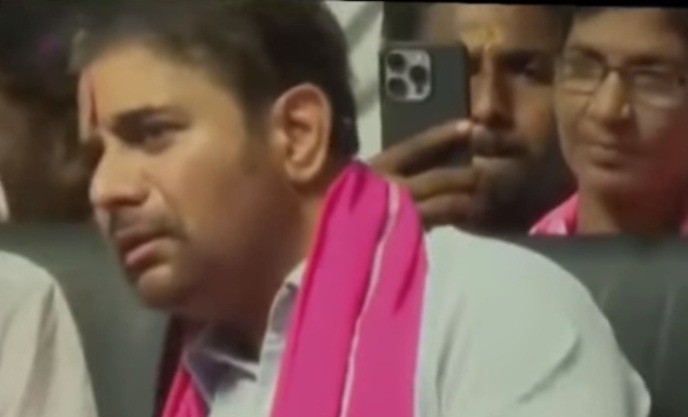
He once resembled Rajesh Khanna, carried himself with the shyness of Aamir Khan, and now seems to have transformed into Ranveer Singh overnight. KTR appears to be gearing up for a Dhurandhar-style elevation. Whatever the explanation behind his new look, there is growing speculation that BRS working president K.T. Rama Rao is reinventing himself ahead of the next electoral battle. There is a story behind this transformation, and to understand it, we need to revisit the past.
In Hyderabad and much of northern Telangana, certain North Indian cultural influences are common. Many men prefer a clean-shaven look, keeping their moustaches trimmed or removed rather than growing full beards. KTR, whose full name is Kalvakuntla Taraka Rama Rao, was also known for his clean-shaven appearance.
He returned from the United States during the Telangana movement and entered active politics. By then, KCR had already emerged as the movement’s central leader, while Harish Rao was widely seen as the party’s second-in-command. KTR’s entry, followed by Kavitha’s political rise, gave the movement a new dimension, with the family increasingly seen as the next generation of leadership.
After Telangana was formed and the BRS came to power, that family-centric image became even more prominent. KTR became a minister, while Kavitha entered Parliament as an MP. With his educational background, business acumen and communication skills—qualities often compared with those of his father—KTR established himself as a prominent face of the government. He built strong connections in business circles and represented Telangana at international forums as the state’s IT minister. A decade in power further strengthened his political position.
After the party returned to power for a second consecutive term, KTR increasingly appeared to be an alternative centre of authority to KCR. His appointment as BRS working president reinforced the perception that he was the political heir. Within his camp, expectations were high that the party would win a third consecutive term and that KTR would become Chief Minister.
However, Revanth Reddy and the Congress overturned those expectations by winning the 2023 Telangana Assembly elections. Paradoxically, the defeat also gave KTR an opportunity to reshape his public image. Out of power, he began spending more time among the people, while his political style appeared to shift from an emphasis on polished presentation towards a more aggressive, mass-oriented approach. Despite facing a series of legal challenges and allegations, KTR has continued to attack the ruling government rather than retreat from the political spotlight.
As dissatisfaction with the Revanth Reddy government becomes a subject of political debate, KTR has stepped up his criticism. Kavitha’s departure from the party and her subsequent allegations have not, so far, visibly displaced KTR from his central position within the BRS. With KCR less active on the ground than in the past, KTR appears to be taking on a larger share of the party’s day-to-day political leadership. The extent to which KCR continues to guide the strategy from behind the scenes remains a matter of political interpretation.
The verbal sparring between Revanth Reddy and KTR is already familiar to Telangana voters. Revanth is known for his earthy rhetoric and his trademark beard and curled moustache, which often feature in his political challenges. During the previous election campaign, he also made remarks about KTR’s clean-shaven appearance. KTR, meanwhile, did not have a similar visual trademark to use in such exchanges.
Now, with the next Assembly election still some time away, KTR appears to be preparing early for the political contest. The atmosphere already feels like an extended campaign. In the past, critics accused him of benefiting from his overseas background and of accumulating influence and wealth while in power. Allegations of corruption have also remained part of the Congress’s attacks on the BRS leadership. These are political allegations, not conclusions established here.
Against this backdrop, KTR’s apparent shift from a polished, urban image to a more rugged and mass-oriented look may be an attempt to change public perceptions. There is also speculation that he could spend more time among ordinary voters and consider a statewide padayatra if the political circumstances warrant it. His changing appearance has therefore become a talking point in the wider debate over his political strategy.
The Chief Minister’s post, which many in the BRS camp had expected KTR to secure in 2023, slipped away after the party’s defeat. Now, the moustache has become a symbol in the political narrative surrounding his possible ambitions. Whether this new look is simply a personal choice or part of a deliberate image makeover remains unclear.
The political landscape could change before the next election. Developments at the national level, the relative strength of the BJP and Congress, and public sentiment in Telangana could all influence the contest. KTR’s prospects of becoming Chief Minister will ultimately depend on electoral results, the BRS’s organisational strength and the choices voters make.
For now, one question continues to fuel political discussion: is KTR merely changing his look, or is he preparing for a bigger challenge? The answer will become clearer as the next election approaches. Until then, the message from the pink camp seems to be: twirl that moustache, Gulabi Raja!