

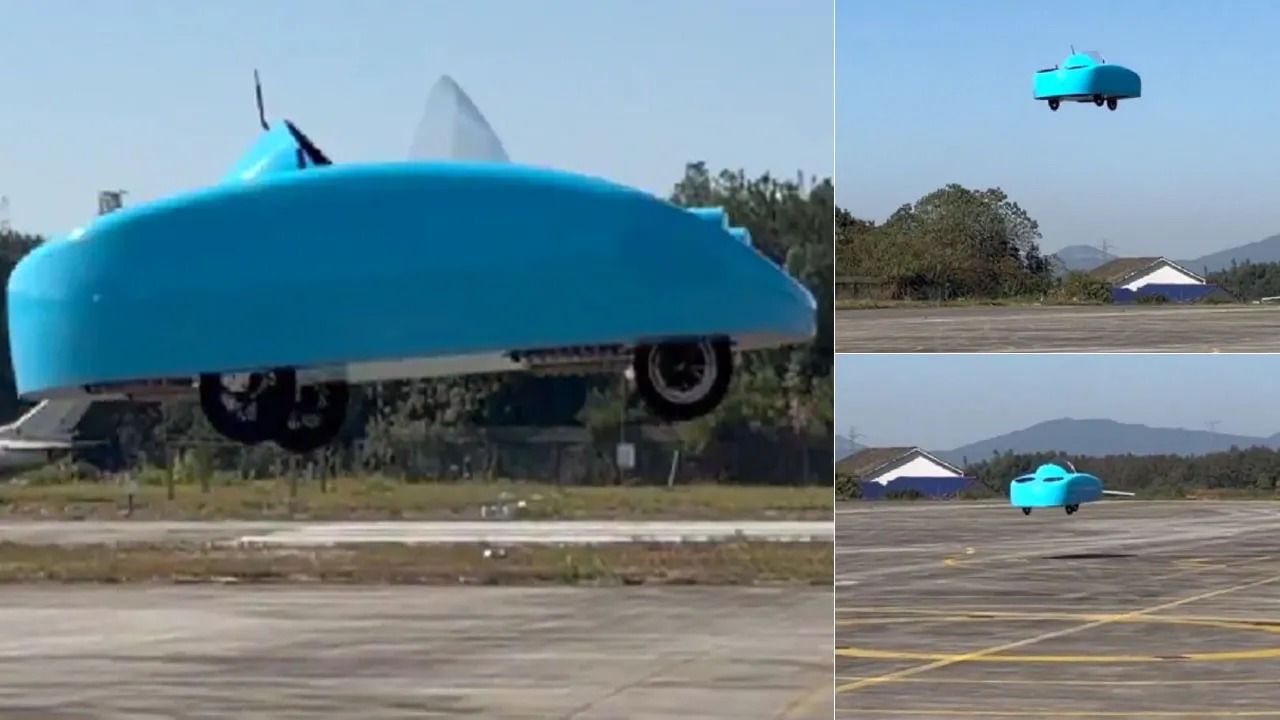
China has taken another major step towards transforming the future of transportation with an exciting new flying car experiment. Unlike conventional aircraft that require a runway to accelerate before taking off, this innovative vehicle can rise vertically into the air like a helicopter. The flying car successfully completed an experimental test in Changsha, China, demonstrating its ability to take off directly from the ground, hover steadily in the air for a period of time and land safely at a designated location. The vehicle is reportedly similar in size to a conventional compact car, making the technology particularly interesting for future urban transportation.
The details of this innovative technology were shared by Xu Feihong, China’s Ambassador to India, through a post on the social media platform X. A video accompanying the announcement reportedly showed the vehicle lifting directly into the air without any runway assistance. According to the ambassador, the flying car has a take-off weight of 280 kilograms and a payload capacity of 120 kilograms. He also highlighted its enclosed fan design, which keeps the blades hidden inside the vehicle rather than exposing them like the propellers found on conventional drones and helicopters. This design is expected to improve safety and make the vehicle more suitable for use in future urban environments.
One of the most distinctive features of the flying car is its advanced propulsion technology. Instead of using externally visible propellers, the vehicle reportedly employs a multi-stage thrust-vectoring ducted fan system. The fans are safely integrated into the vehicle’s structure and generate downward airflow to lift it off the ground. By directing and controlling the thrust, the system enables vertical take-off, stable hovering and controlled landing. The enclosed design could potentially reduce the risks associated with exposed rotating blades, particularly in crowded urban areas. If further developed and certified for public use, this technology could offer an alternative approach to short-distance transportation in cities where road congestion is a major challenge.
The development has also drawn attention because of comparisons with the technology being explored by Tesla for its Roadster. However, the two concepts reportedly use different approaches to aerial movement. Tesla’s proposed Roadster technology has been associated with SpaceX-developed cold-gas thrusters, while China’s flying car uses an integrated ducted fan propulsion system designed for vertical take-off and sustained hovering. The Chinese prototype is therefore focused on demonstrating a different method of achieving controlled flight from a compact vehicle platform.
Despite the excitement surrounding the successful test, the vehicle is still at an early stage of development. The model demonstrated so far is reportedly a basic single-person prototype rather than a fully developed commercial flying car. Several more stages of technological development, safety testing and regulatory approval may be required before such vehicles can become available for everyday passenger transportation. Nevertheless, the successful demonstration of vertical take-off, hovering and landing represents an interesting development in the field of aerial mobility. As companies and researchers continue exploring new transportation technologies, China’s latest flying car experiment has added another possibility to the vision of future cities where vehicles may travel not only on roads but also through the air.