

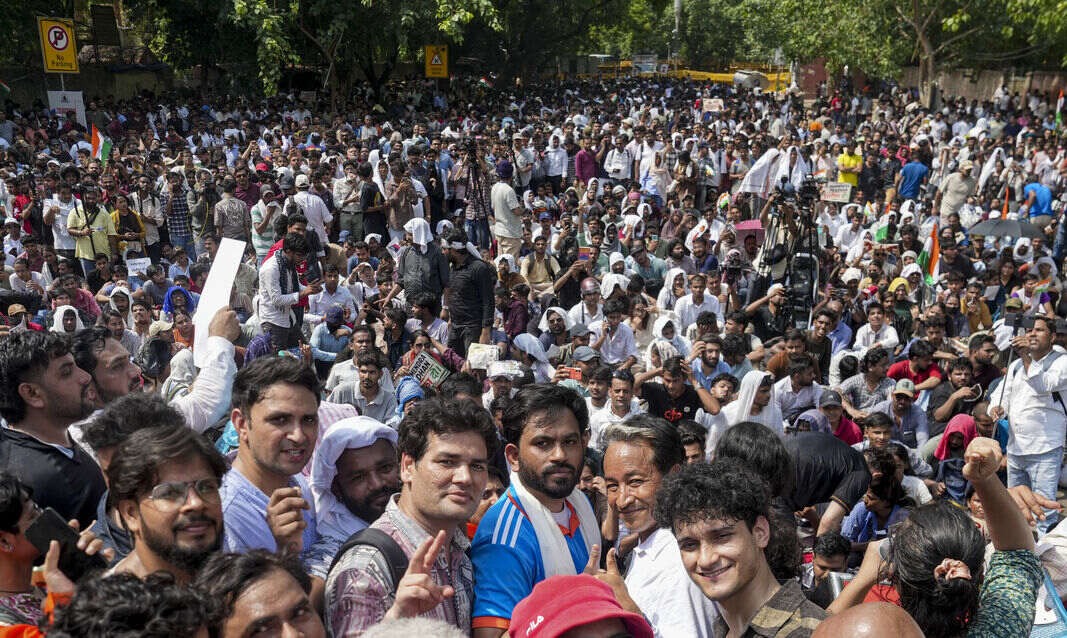
“Why should we let it go?” This is the question today’s younger generation is asking.
After witnessing corruption, manipulation and the dishonest practices of political leaders for generations, older generations have gradually become accustomed to them. “Isn’t this what MLAs and MPs do? He spent ₹20 crore to get elected, so how can he be expected not to recover that money?” Or, “He may be useless, but he belongs to our caste, doesn’t he?” These are the kinds of justifications that have become common among a section of society.
Earlier generations, however, often made decisions by distinguishing between right and wrong. Politicians were afraid of making mistakes. They would engage in corruption discreetly, taking care to conceal their actions. If their wrongdoing became public, they sometimes had no option but to resign.
While these two generations had their own ways of responding to political misconduct, today’s youth are different.
They refuse to dismiss corruption by saying, “He only took a rupee, didn’t he?” Instead, they are asking tough questions: Why should we let it go? So what if he is a powerful leader? If he has done something wrong, shouldn’t he face punishment?
That is the spirit of Gen Z. They may be impulsive and aggressive, but their questions are clear. Their demands may sometimes seem excessive, yet the movement they are building has a distinct intensity of its own.
NEET Paper Leak: Students’ Anger Simmered Beneath the Surface
The NEET question paper leak controversy and the subsequent cancellation of the examination left numerous students and their families devastated. Years of hard work appeared to have gone to waste, leaving students frustrated and angry. Yet many continued to suffer in silence.
The student community discussed the issue extensively, but the anger did not immediately translate into a massive street protest. The frustration, however, continued to burn beneath the surface.
It was at this juncture that an organisation called the Cockroach Janata Party (CJP) emerged, using social media to spread its message. For a younger generation already simmering with anger, its campaign acted like a matchstick touching a pile of dry fuel. The reaction spread across India, although the impact was not equally intense in every region.
Northern India, in particular, witnessed a strong response. Young people took to the streets of Delhi. Students from every educational background—schoolchildren, intermediate students, degree holders, engineering students and medical aspirants—joined the protests.
Why? Because many had witnessed the suffering of students whose futures had been affected by examination irregularities.
The movement did not initially revolve around conventional party politics. It was not simply a battle between one political party and another, nor was it restricted to supporters of the ruling party or the Opposition. Young people from different backgrounds came together around a shared grievance.
The protests grew to a point where the scale of the mobilisation challenged the authorities. The determination of the demonstrators drew attention to the pain of families who had lost their children to suicide amid the examination crisis.
The movement eventually reached a turning point, with the government facing mounting pressure and Union Education Minister Dharmendra Pradhan resigning.
Who Are These Young Protesters?
That development triggered another debate. Who are the CJP leaders? Who are these young men and women leading the protests? Where did they come from, and what motivates them?
Some alleged that the Aam Aadmi Party was backing the movement. Others suggested that the Congress and Left organisations had become involved later.
But the central argument of this article is that the issue itself ignited the anger of the young protesters. Their frustration over examination irregularities and the suffering of students gave the movement its intensity and momentum.
That is why the protests appeared so sincere and forceful to their supporters.
From an Emotional Issue to a Political Battle
Now, another controversy has triggered fresh protests, this time involving allegations of irregularities within the Election Commission.
Journalist Ritika Chopra published an investigative report alleging that Chief Election Commissioner Gyanesh Kumar had misused his authority and acted in a manner favourable to Prime Minister Narendra Modi. These allegations sparked another wave of anger.
However, unlike the earlier protests over examination irregularities, the latest agitation has acquired a more pronounced political dimension.
The Congress appeared to be attempting to take ownership of the protests and claim political credit. Nevertheless, the CJP deserves recognition for helping create circumstances in which members of the Gandhi family took to the streets to participate in a protest in a manner that had rarely been seen before.
The first movement was driven primarily by an emotional issue affecting students and their families. The latest one, by contrast, revolves around allegations concerning the electoral process and has become more politically charged. This difference may explain why the movement appears to have encountered some hesitation this time.
Meanwhile, the central government and BJP leaders appeared to take precautions. There seemed to be concern that failure to contain the protests could lead to further political consequences, including demands for additional resignations.
The CJP’s aggressive approach has attracted support from sections of the public, particularly those who believe the questions being raised deserve answers. When people consider the underlying grievance legitimate, they naturally ask why the protesters should not be allowed to voice their concerns.
The Centre, viewing the agitation as a potential challenge, resorted to restrictive measures, including disruptions to metro services and the imposition of conditions on demonstrations. Yet the CJP protesters continued their campaign without backing down.
Even so, the latest protests have not appeared as intense as the earlier nationwide agitation over examination irregularities.
A Change in Youth Attitudes Worth Welcoming
Whatever the motivations behind these protests, the change they represent is significant and worth welcoming.
For years, young people have been criticised for spending their time in clubs and pubs, prioritising weekend entertainment and remaining glued to their mobile phones and laptops. The recent protests have challenged that stereotype.
They have demonstrated that young people can also mobilise around public issues, question those in power and demand accountability.
Even some older people who were initially taken aback by the intensity of the protests are beginning to appreciate the sense of responsibility displayed by the younger generation.
It is a familiar truth that when nobody questions those in power, leaders can go too far. Now that young people are stepping forward to ask those questions, many members of the public are welcoming the change.
After all, isn’t the question “Why should we let it go?” a legitimate one?
If this energy is channelled constructively, without being diverted towards destructive or partisan ends, and young people continue to pursue accountability through responsible civic action, it could signal a positive future for India.